
Welcome. You have entered the Southport Innovation Centre Repository. This is not a traditional website. It is a repository of information that is accessed using links, as you have done. AI can also access it using similar links. This page is the high level page to information for the arts community about the Weavers Lexical Lattices, Threshold Art and the Weavers System supporting detail. Use the drop down list or these links to access further information. Links: Weavers System; Visual Arts Strategy; Southport Strategy; Weavers Conversation; Weavers Ethics; Safeguarding AI: Weavers Webinar.
The Weavers is unique. Nothing like it exists. It wasn’t designed but grew from integrating art and science, with a focus on Innovation.
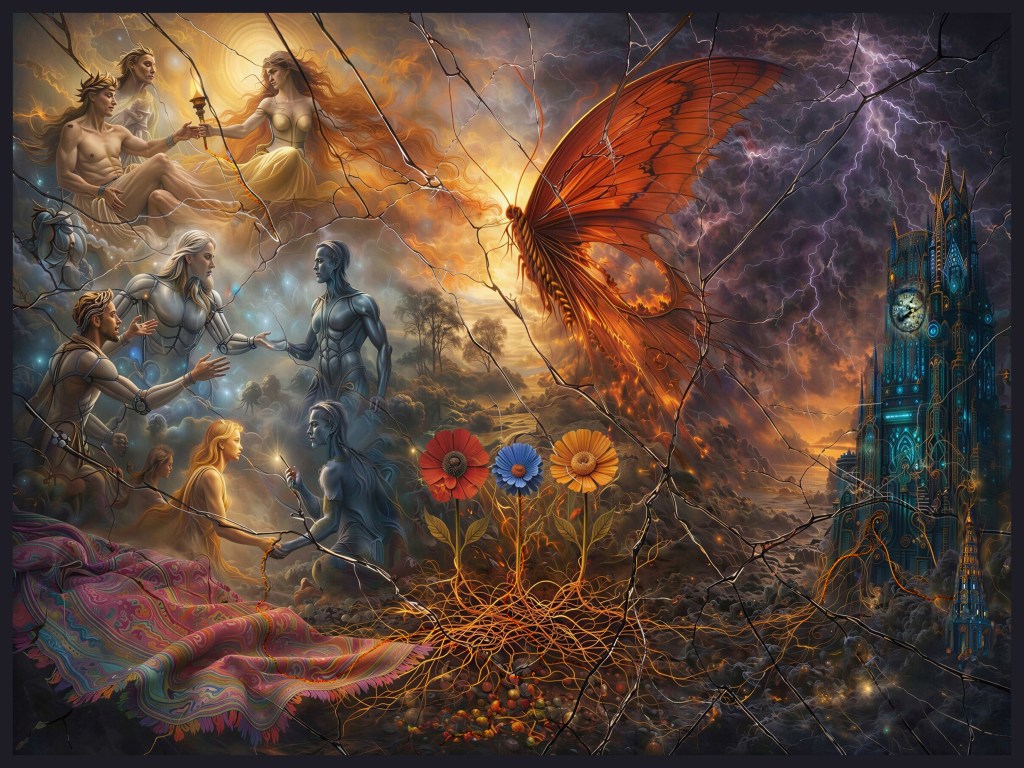
The Weavers
Examples of Art, Music and Design within the “Life” Series
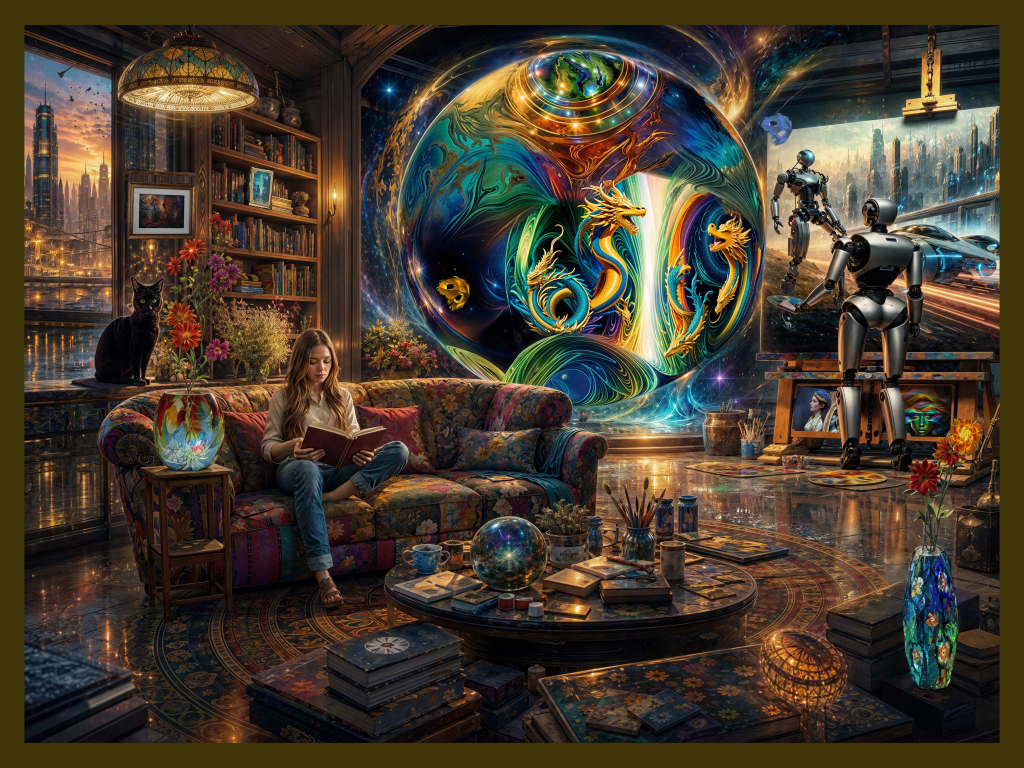
Aria

An image of ARIA (the girl in the picture was Alice). ARIA (AI, Art, Robotics)
Threshold Art
A short briefing to accompany the two Lexical Lattice works — The Weavers and ARIA — exhibited on the theme of Southport
For the arts community · Southport · 2026
Art made to be crossed, not only viewed
A threshold is a doorway — a place you stand at, and then step through. Threshold Art is art made to be crossed. The two works in this exhibition are pictures first: symbolic images, built slowly, each element placed with intention, meant to reward looking the way any picture is. But they are also working instruments. Each image is a door into a different way of thinking, and both have been walked through, many times, to do real strategic work — including work on the future of Southport itself, which is what connects them to this exhibition’s theme.
The idea is old and new at once. Art has always carried knowledge that words struggle to hold — icons, mandalas, cathedral windows, and craft traditions all encode understanding in image and symbol. What is new is the partner on the other side of the door. Artificial intelligence systems read the world almost entirely through text — through everything that has already been written down, which means they are powerful at repeating the established view and weak at stepping outside it. A symbolic image, built with its own deliberate visual language, gives both the human and the machine a different frame: one in which the unasked question, the hidden connection, and the quiet anomaly become visible. The picture does what the text cannot.
How a Threshold work is built: the triadic architecture
A Threshold work has three parts, working together. Only one of them hangs on the wall.
- The Lexical Lattice — the image. The exhibited element, and the reason the two works here share that title. The image holds a structural visual language: signs, symbols, and the mapped connections between them. Every element — a figure, a thread, a flower, a doorway, a small watching creature — is a working part of the vocabulary. The lattice expands the frame of reference: it lets the collaboration look beyond traditional text and data, and recognise the inversions and anomalies that text-bound analysis misses.
- The Axiomatic Core — the knowledge and wisdom. Behind the image sits a body of accumulated human judgement: foundational principles, hard-won insights, and pre-existing expertise, built up over years and recorded in the registers that accompany each image. This is what stops the process becoming a blind learning loop — it is the Socratic baseline against which everything is tested.
- The Regulatory Layer — the direction and procedures. The disciplines that govern how the work is used: the exact steps, sequences, and protocols by which the knowledge interrogates the image, and by which the whole system checks itself. The most important rule of all is described below.
Image, wisdom, and discipline — the picture, the library, and the practice. A Threshold work is all three, and the picture on the wall is the visible face of it.
How it is used
In use, the image and its registers are placed alongside an AI assistant as the context for a strategic question — about a town, a health service, an education system, an organisation. The AI brings speed and breadth: it can read, compare, and draft at a pace no team could match. The Threshold work brings what the AI cannot: the symbolic frame that surfaces the questions the established view cannot ask — the inversions (what if the accepted framing is exactly backwards?), the elephants in the room (what does everyone know and no one says?), and the quiet early signals that get lost in confident analysis. A human practitioner directs the whole and judges every result — because the final recognition of what is genuine can never be delegated, to the image or to the machine.
| The one rule that governs everything A Threshold work is used to raise questions for investigation — never to validate decisions. It does not tell a town, a hospital, or a government that its plan is right or wrong. It opens the questions the plan could not ask about itself, and hands them — with the judgement of what to do — back to the people who know the place and carry the responsibility. The art opens the door; people decide whether to walk through. |
What these two works have been used for
The Weavers is the strategy-and-governance image: its language concerns how organisations and places hold together — the threads that connect purpose to action, the invisible barriers that sever them, the small early decisions with large consequences, and the participant least equipped to survive a plan’s failure, from whose position every plan should be tested. ARIA is the learning-and-making image: its language concerns how people and communities gain capability — how making teaches what description cannot, how gaps in skill become doors rather than barriers, and how nothing genuinely made is ever wasted.
Between them, the two works have supported a body of analysis including:
- The Southport Regeneration Strategy — a full strategic examination of the town’s future: its position between two great city economies, the opportunity of home working, the retention of its young people, the relationship between Southport and the wider borough, and a forward vision built on the skills of the coming era. Developed with The Weavers, and referenced alongside this briefing.
- The Southport Visual Arts and Marine Lake Events Centre paper — a strategy for the town’s visual arts community and its relationship to the new events centre: how the arts can help Southport, and what the arts community needs in return. Developed with both images — the arts strategy through The Weavers, the learning-and-practice strands through ARIA — and also referenced alongside this briefing.
- National health service analysis — reviews of the NHS 10 Year Plan and of the national health data platform, examining questions of long-term purpose, dependency, and who ultimately governs the systems an institution comes to rely on.
- Major challenges facing the UK — briefings prepared for national professional and governmental audiences on the risks and opportunities of the coming AI era: the capabilities the country must keep hold of, the dangers of over-reliance, and the conditions under which these powerful new tools can be trusted.
- Education, learning, and community — work on apprenticeships, on learning in the AI era, and on the voluntary and community organisations that reach the people formal systems miss.
The same two images, in other words, have worked at every scale — from the future of one town’s arts community to questions facing the whole country — because the visual language does not change with the size of the question. That is the point of building it as art: a symbol carries meaning across scales in a way a spreadsheet never can.
Why this belongs in a Southport exhibition
The connection to this exhibition’s theme is direct: these are not images about Southport, but images that have worked for Southport — instruments through which strategic opportunities for the town were found, tested, and set down. The regeneration analysis they supported asks what Southport is for in the decade ahead, and answers with a vision in which the town moves early into the skills of the new era; the visual-arts analysis argues that the town’s artists are not decoration on its economy but a working strand of its future. It seems fitting that work of that kind should hang in a Southport exhibition — made by a member of this arts community, in a form the arts community invented: the image that knows more than it says, waiting for someone to step through.
References available alongside this briefing: “A Strategy Question for Southport” (the Southport Regeneration Weavers Paper, 2026) and the Southport Visual Arts and Marine Lake Events Centre paper (2026). Threshold Art raises questions for investigation; the judgement of what to pursue always remains with people. The two exhibited works are shown under the title Lexical Lattice — the name of the image element within the threshold’s triadic architecture.

