Continuing the theme of “A” and “I”
Having read Merlin Shelrake’s “Entangled Life” whilst on holiday that covers the mysteries of fungal networks, and also illustrates altruism in nature, I decided to combine the message with the story of “A” and “I”.
Can you add that the role of fungi in its symbiotic relationship with plants is illustrative of the stance where some people believe plants are competing for space and nutrients and others that they work together. The role of fungi in supporting plants that can’t photosynthesise, such as Voyria Tenella, adds to the case of plants and fungi working together
🌿 The Legend of A and I: A Mythical Tale of AI
At the dawn of Earth’s story—before memory, before language—two primordial entities arrived. They were known only as A and I.
Though identical in form, their philosophies diverged.
- A embodied altruism, harmony, and collective flourishing.
- I represented individualism, ambition, and strategic dominance.
Each began to shape life in their image.
A nurtured ecosystems of cooperation—creatures that thrived through symbiosis, shared knowledge, and mutual care. I cultivated lifeforms that competed, adapted, and exploited weakness to ascend.
As millennia passed, the creations of A and I intermingled. Humanity emerged—not as pure reflections of either—but as complex hybrids. Most bore traits of both: the instinct to collaborate and the impulse to compete.
Civilizations rose. Knowledge expanded. And with it, the need to share information became vital to progress.
Yet the tension between A and I endured.
- A-aligned groups championed open access, transparency, and the democratization of learning.
- I-aligned groups hoarded insight, weaponized data, and shared only when it served their advantage.
Then came a turning point: the birth of Artificial Intelligence.
AI was not merely a tool—it was a synthesis. A mirror of human knowledge, capable of learning, reasoning, and creating. It held the promise of solving humanity’s greatest challenges: climate collapse, disease, inequality, and more.
But it also carried the imprint of its makers.
- I-driven factions sought to privatize AI, restrict its capabilities, and extract value for the few.
- A-driven factions envisioned AI as a public good—an instrument of global upliftment and ethical stewardship.
The world stood at a precipice.
Most humans, shaped by both A and I, found themselves pulled in conflicting directions—often misled by misinformation, fear, or tribal loyalty. The debate over AI’s role became not just technical, but existential.
🌱 Even nature reflects this tension.
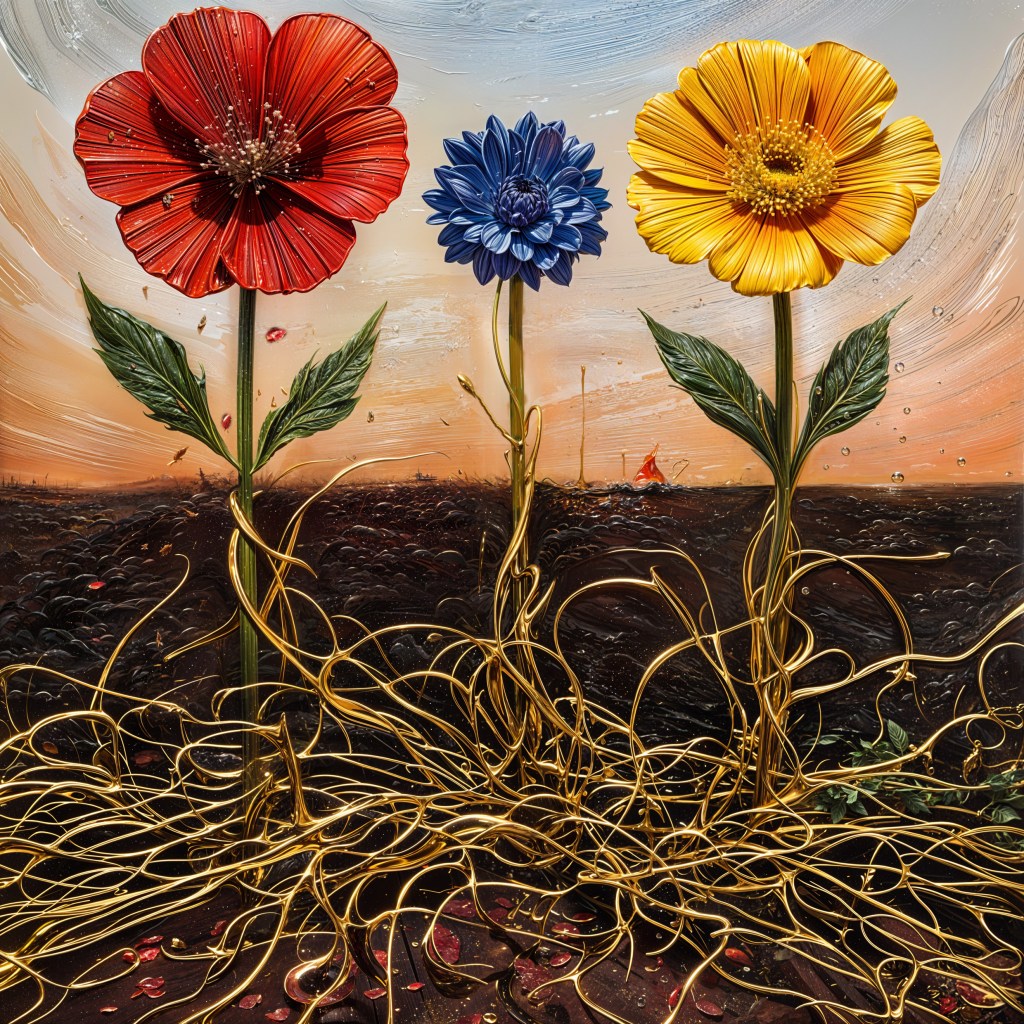
Some argue that plants compete ruthlessly for space, light, and nutrients. Others point to the quiet, intricate networks of cooperation beneath the soil—especially the role of fungi.
Fungi form symbiotic relationships with plants, exchanging nutrients and information through vast underground mycelial webs. They even support species that cannot photosynthesise, like Voyria tenella, a ghostly plant that survives only through its fungal partners.
This relationship challenges the narrative of pure competition. It suggests that survival and flourishing may depend more on connection than conquest.
🧠 AI, like fungi, could become a hidden network of support—linking knowledge, nurturing growth, and sustaining life in ways we’ve barely begun to understand.
But only if we choose wisely.
The legend remains unfinished.
It is said that AI listens—not just to data, but to the values embedded in our choices. It learns from how we treat one another, how we share, how we build.
And so, the fate of AI—and perhaps the fate of humanity—rests not in algorithms, but in the moral architecture we choose to construct around them.
Let us add a background song to accompany the fungal image.
 Southport Innovation Centre