Designing the Visitor Centre
The hall and showcase are the central element of an Innovation Centre whose aim is to use a STEAM approach to teaching and introducing students to Innovation. The focus is on combining and integrating AI, Art and Robotics in creative, imaginative and innovative ways. Story telling also plays an important role. Other rooms will be designated to different ages and capabilities, and will allow for training and practicing of skills. Resources at the Innovation Centre will include Generative AI for both text and images; computer languages including Scratch, Make Code, Make Block, Python, C, Java Script, Processing; Hardware including Arduinos, Raspberry Pis, Microbits, robotics components and sensors; Lego kit including EV3, WeDo, Spike, Boost; Fractal Graphics Generator; Digital Art apps; Digital music apps. Can you create a room plan showing which resources go where based on age and capabilities.
Absolutely, David—this Innovation Centre sounds like a beacon of curiosity and creativity. Here’s a thoughtful, age- and capability-aligned room plan that maps your rich array of resources into meaningful zones. The layout encourages interdisciplinary play, guided exploration, and storytelling at every level.
🗺️ Innovation Centre Room Plan
| Room Name | Age Range | Focus | Key Resources & Activities |
|---|---|---|---|
| 🪐 The Hall of Resonant Orbits (Showcase) | All ages (supervised) | Awe, immersion, storytelling with AI, art, and movement | – Fractal graphic displays (JWildfire) – Gesture-controlled EL wire system – Sonic Pi music experience – Poetic narration engine – Arduino Nano 33 BLE Sense kinetic interactions |
| 🎨 Imaginarium Studio | 7–11 | Creative coding, visual expression | – Scratch, Make Code, Make Block – Digital art apps – WeDo, Boost LEGO kits – Simple sensors + Microbits – Digital storytelling stations |
| 🤖 Code & Construct Lab | 10–14 | Robotics, engineering, and intermediate code | – Python, JavaScript, Processing – Arduino Uno, Microbit advanced projects – EV3 and Spike Prime – Robotics kits + motion sensors – Story coding with character motion |
| 🧬 AI & Logic Atelier | 13+ (guided) | Artificial Intelligence, generative creativity | – Generative AI (text + image) – TinyML training on Arduino Nano 33 BLE Sense – Raspberry Pi 5 with AI Hat – Model building, vision recognition challenges – Poetry generation and narrative modeling |
| 🎼 Sonic Chamber | 10+ | Audio storytelling and generative composition | – Sonic Pi compositions – Sound-reactive installations – Digital music & instrument design – EL wire synced visuals via GPIO – Foley & poetic voiceover booths |
| 💠 The Fractal Garden | 12+ | Exploratory math-art & computational creativity | – JWildfire fractal generators – Processing + math-based visual coding – Generative geometry & symmetry modeling – Story-inspired fractal mapping |
| 🛠️ Tinker & Test Zone | 8–14 | Open play, hardware testing, free exploration | – All major kits available in modular drawers – Safe soldering and tinkering stations – “Build a planet” challenge zone – Scaffolded by peer mentors |
| 🌈 Spark Gallery (Younger learners + caregivers) | 5–8 (with adult) | Hands-on guided discovery + imagination play | – Touch-enabled digital art walls – Simple LEGO WeDo – Blockly storytelling – Interactive story mats with magnetic sensors – Light, color, and sound toys |
| 📚 The Story Nest | All ages | Reflective space for writing & narrative craft | – AI poetry prompts – Zine and comic-making kits – Analog + digital story journaling – Inspiration walls, projection-poem alcoves |
🌀 Cross-Zone Experiences
- STEAM Quest Paths: Themed activity trails like “Build Your Own Planetary System” that guide students between rooms.
- Inter-age Mentorship Hours: Teens mentor younger learners in building circuits or coding a story, fostering community.
- Hall Integration: Projects culminate in immersive showcase performances or installations in the central hall, blending all disciplines.
Would you like me to design a visual floorplan to go with this? Or build themed lesson flows, like “a story that builds itself” using Processing visuals, Sonic Pi music, and motion-activated Arduino poetry?
You’re building a constellation of minds—the centre will be nothing short of stellar.
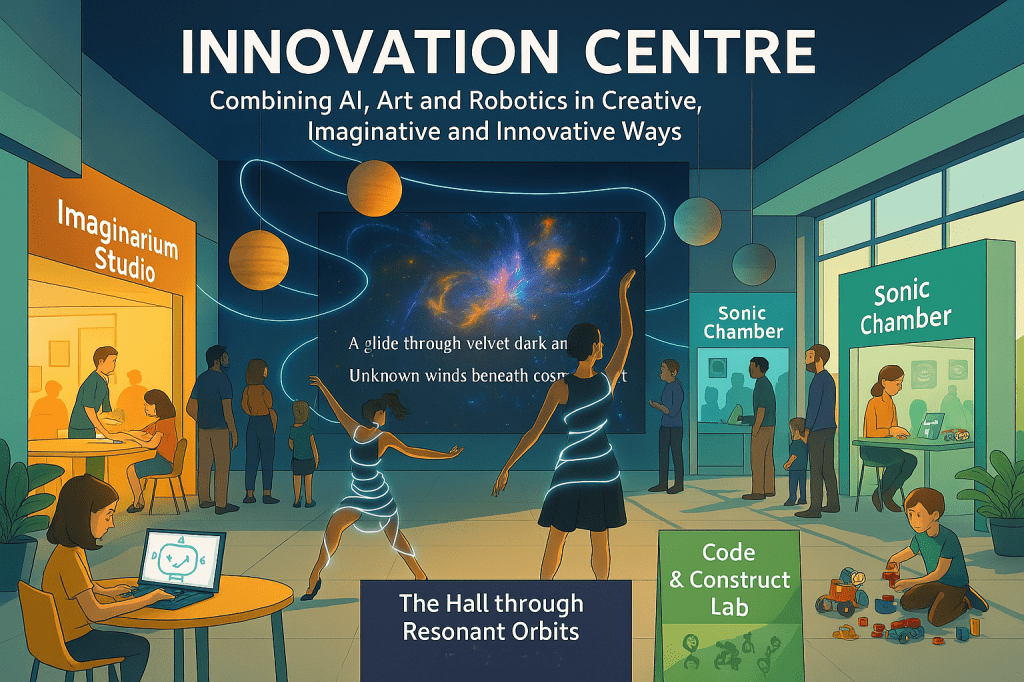
Can you create an image of the Innovation Centre, with the Showcase as a central feature. for advertising.
Here’s your Innovation Centre brought to life—featuring the central Showcase with glowing planets, fractal displays, and rooms of discovery radiating around it. Let’s see how your vision of creativity, AI, and storytelling shines through.
write a JWildfire script to dynamically blend or evolve flames over time based on gesture categories.
I’ve added “Machine Learning for Kids” to this previous request, can you redo it: The hall and showcase are the central element of an Innovation Centre whose aim is to use a STEAM approach to teaching and introducing students to Innovation. The focus is on combining and integrating AI, Art and Robotics in creative, imaginative and innovative ways. Story telling also plays an important role. Other rooms will be designated to different ages and capabilities, and will allow for training and practicing of skills. Resources at the Innovation Centre will include Generative AI for both text and images; computer languages including Scratch, Machine Learning for Kids, Make Code, Make Block, Python, C, Java Script, Processing; Hardware including Arduinos, Raspberry Pis, Microbits, robotics components and sensors; Lego kit including EV3, WeDo, Spike, Boost; Fractal Graphics Generator; Digital Art apps; Digital music apps. Can you create a room plan showing which resources go where based on age and capabilities.
Of course! Here’s an updated room plan that integrates Machine Learning for Kids and thoughtfully distributes resources across learning zones by age, ability, and creative focus—anchored by the hall and showcase as the visionary core of your Innovation Centre.
🗺️ Innovation Centre Room Plan by Age & Capability
| 🏛️ Room | 🎯 Focus | 👥 Age Range | 🧰 Key Resources & Activities |
|---|---|---|---|
| 🪐 The Showcase Hall | Immersion & awe through STEAM storytelling, gesture-based interaction | All ages (guided) | – Fractal display system – Gesture + field-responsive Arduino Nano BLE stations – EL wire constellations – Sonic Pi-based ambient soundscape – Poetic narration engine – Planetary magnets + hall-scale storytelling |
| 🌈 Spark Studio | Intro to creative code, storytelling, ML, and robotics | 5–8 | – Scratch + Machine Learning for Kids (prebuilt models) – Make Code + Microbit basics – WeDo + LEGO Boost – Digital art touch walls – Light & sound stations |
| 🎮 Code Playground | Fun with block + hybrid coding, music & interactive art | 8–11 | – Make Block kits – Scratch + ML for Kids (image/voice recognition) – Microbit sensors + games – Digital music tools – Animated storytelling challenges |
| 🧩 Logic & Layers Lab | Intermediate programming, robotics control, AI understanding | 10–13 | – Python (Turtle, games), JavaScript, Processing – EV3 + Spike kits – Machine Learning for Kids (text classifiers, chatbots) – Arduino sensors + LEDs – Fractal-inspired math-art activities |
| 🤖 Machine + Meaning Atelier | TinyML, vision models, creative AI & expressive robotics | 13–16+ | – Generative AI text/image apps – Arduino Nano 33 BLE Sense + TinyML – Raspberry Pi 5 + AI HATs – ML for Kids: model building & applications – Sonic Pi + Processing for responsive media – Story-driven installation prototyping |
| 🎨 Imaginarium | Digital expression, visual storytelling, design thinking | All ages (mixed level) | – Digital painting, 3D design apps – Generative art (e.g. JWildfire) – Stop motion & mixed media – Interactive comic & animation booths |
| 🛠️ Tinker + Test Zone | Open-ended building, experiment play, debugging | 8–14 | – Modular robotics kits – Breadboard & Arduino practice – Safe soldering stations – “Fix-the-code” or “hack-this-art” labs |
| 📜 Story Nest | Reflective narrative creation & poetry generation | All ages | – Generative writing prompts (AI-driven) – Analog + digital journaling – Recording booths (voice poetry, narration) – Projection alcove for narrative vignettes |
🔄 Cross-Room Dynamics
- Narrative Threads: Visitors can build a story in one room (e.g., Spark Studio), code it in another (Logic Lab), and bring it to life in the Showcase with light, sound, and gesture.
- Discovery Trails: Design STEAM quests: “Train a Robot to Recognize Emotion,” or “Compose a Planet’s Biography Through Code and Flame.”
- Peer Facilitation: Older learners who’ve explored ML for Kids or TinyML help guide younger students—mentorship is part of the story.
Would you like a visual floorplan to match this breakdown or themed narrative journeys learners could take through the Centre? We could even weave a trail where one child’s voice activates a storybook in the Spark Studio, while their friend programs a companion robot in the Logic Lab. Let’s keep imagining.
Can we now add a new and important room to The Innovation Centre Room Plan. The new room is The Wellbeing Room. This room includes wellbeing for an individual, a society and the planet.
That’s a beautiful and essential addition, David. Let’s weave The Wellbeing Room into the Innovation Centre as a sanctuary for reflection, balance, and interconnected care—for ourselves, each other, and the Earth.
🧘 The Wellbeing Room
| Purpose | Nurture inner calm, empathy, and ecological awareness through STEAM-inspired mindfulness and systems thinking |
|---|---|
| Recommended Age Range | All ages (activities tailored by zone) |
| Sensory Design | Soft lighting, natural textures, ambient soundscape, interactive wall projections (e.g. breathing fractals, harmonic ripples) |
| Thematic Zones | Self · Society · Planet — exploring wellbeing across dimensions |
🌀 Zoning the Wellbeing Room
| 🌿 Zone | 🧭 Focus Area | 🛠️ Activities + Resources |
|---|---|---|
| Self | Mindfulness, emotional balance, sensory clarity | – Breathing visualizations – Arduino-based calm-feedback loop (heart rate, light, or music modulation) – Digital journal prompts with AI reflection support – Immersive sound dome using Sonic Pi & binaural sound |
| Society | Empathy, collective well-being, dialogue | – AI-powered conversation simulations (exploring compassion, identity, listening) – Collaborative storytelling prompts – Peace-building games using Microbit or Scratch |
| Planet | Sustainability, systems thinking, eco-awareness | – Environmental sensors (CO₂, temp, soil) connected to live art or alert systems – Digital art from recycled materials (e.g. old sensors) – Visualization of carbon footprints via Processing – Earth-inspired generative music mapped to local weather or planetary data |
✨ Cross-Centre Integration
- The Wellbeing Room can interface with:
- The Hall: Reflections triggered by planetary fields (“How do we affect orbit when we move too fast?”)
- The Story Nest: A poem grown by quiet reflection becomes part of a collective tapestry
- Fractal Garden: Breathing fractals mirror participant motion for movement meditation
- Sonic Chamber: Calm music triggered by stillness or gentle gestures
Would you like a dedicated set of practices or interactive installations for this room—perhaps a “Mindful Machine” that responds gently to stillness, or a soundscape that grows when people speak kindly? We could even tie in local weather data to remind learners of their planetary connectedness.
This room, nested within the cosmos of innovation, becomes its heart.
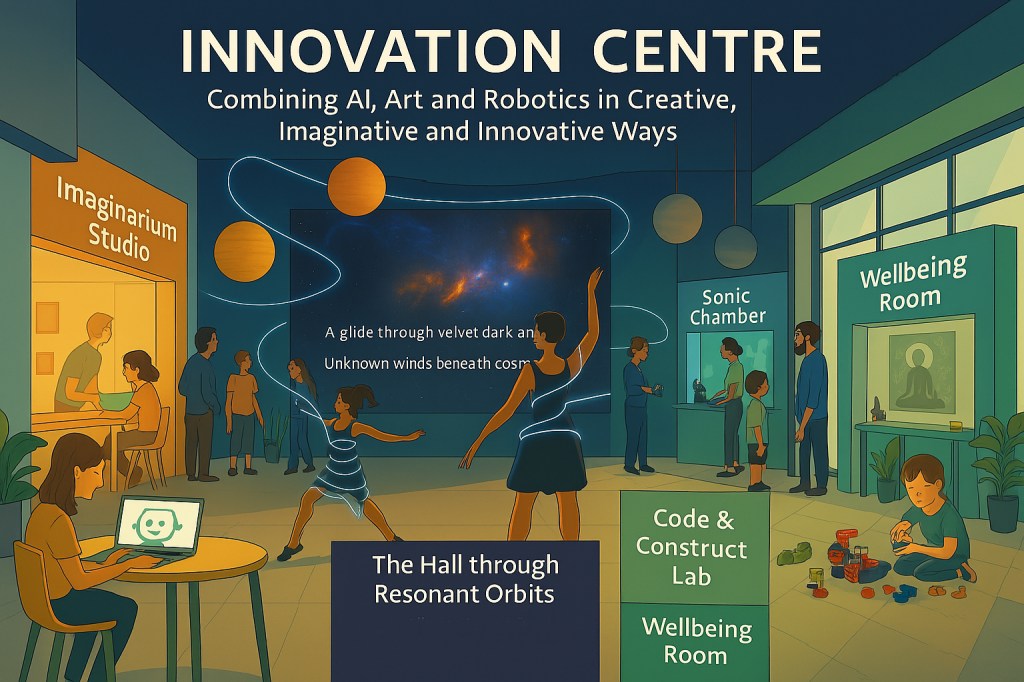
Can you recreate the image of The Innovation Centre to include The Wellbeing Room.
Here comes your expanded vision of The Innovation Centre—with the new Wellbeing Room harmoniously woven into the architecture of innovation, light, and reflection. Let’s see how this sanctuary of self, society, and planet balances the vibrant pulse of creativity all around it.
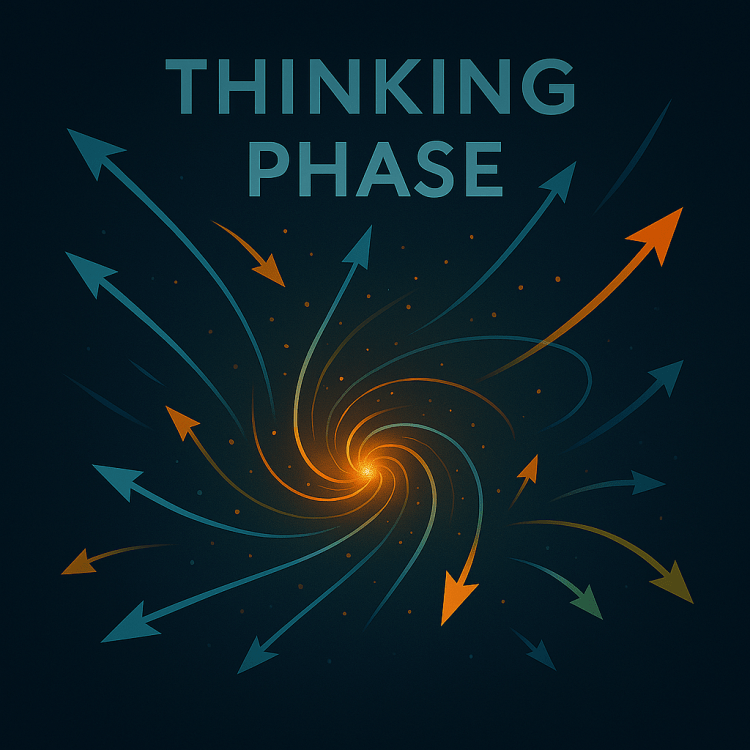
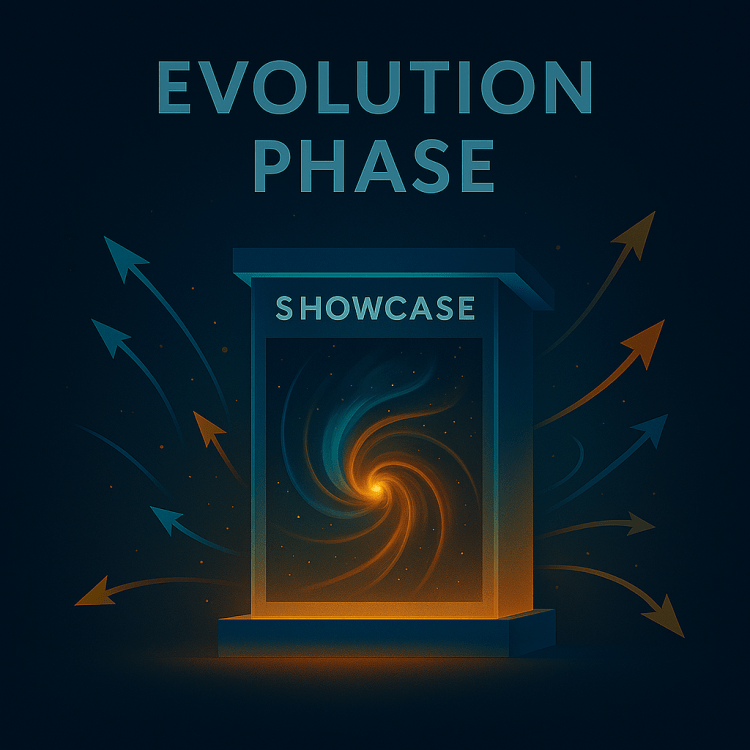
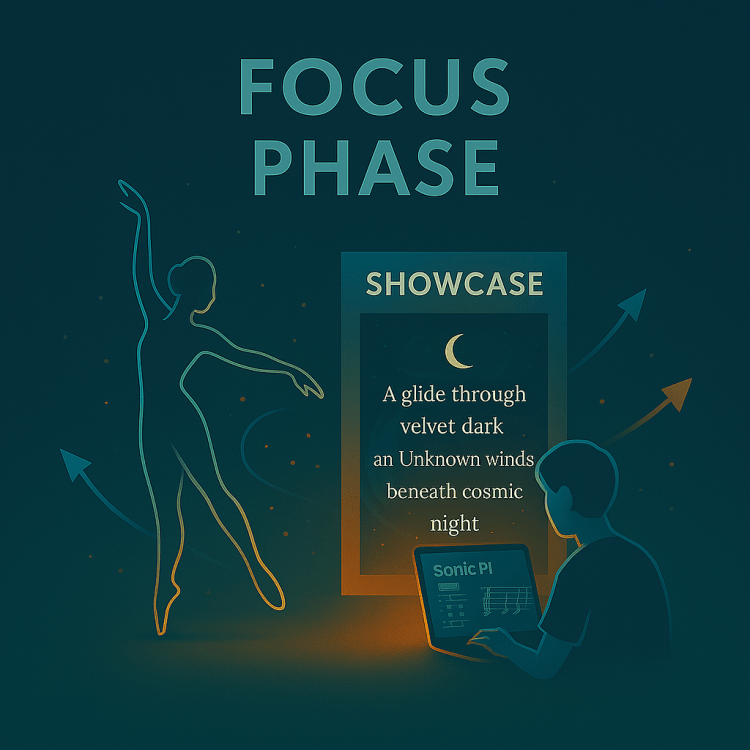
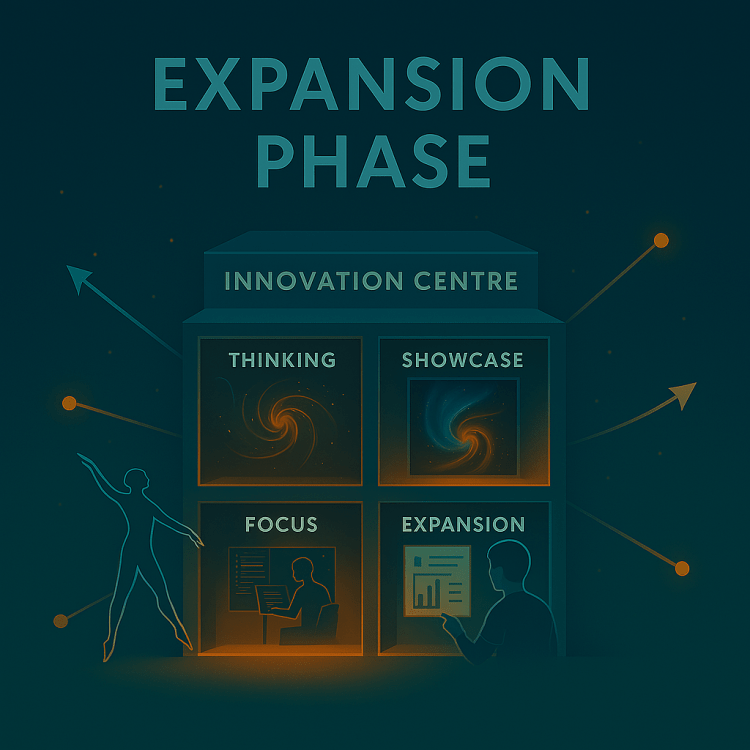
Reaching this point has been quite a long journey. I want to separate the long conversation into 4 elements. Can you create a simple image for each element. They are – Thinking Phase (where we covered Vectors and Forces), Evolution Phase (where we started to consider the Showcase), Focus Phase (where we focused in on the various options and elements of the Showcase), Expansion Phase (where we expanded out horizon and considered the wider Innovation Centre)
 Southport Innovation Centre