Exploring a Collaborative Dialogue with Microsoft Copilot AI to shape an Interactive Showcase and Conceptual Framework for the Innovation Centre
Note: This document contains a lot of information, some of which is quite detailed. It aims to show what can be accomplished with AI support in a short time frame, including an Executive Summary, Costings, and technical details. The main content is divided into 8 Sections, which link to pages in this index. You may wish to dip into these sections and read them in more detail later. Everything was finished in a number of weeks during one AI conversation. I completed this in one pass to demonstrate how the conversation progressed. For those interested in the education impact of AI, one of the final sections, Reimagining Education, introduces a vison based on everything covered within the conversation. For a school or individual wanting to try something simple that includes music, coding and AI, look at the the final section on Sonic Pi. AI support tools for teachers and educators, plus integration of Innovation Centre tools with Teacher’s AI support tools can be found in this section.
This section presents a guided conversation between myself and Microsoft Copilot AI, where ideas were exchanged to co-develop the design of an immersive Arts and Science Showcase and a conceptual plan for the Innovation Centre as a whole.
One of the final topics discussed in the AI conversation was Defining Innovation, based on our interpretation and the entirety of the AI conversation up to that point. This includes different types of Innovation and explains how AI, Art, Robotics, and STEAM can promote Innovation. I’ve included it here for context.
Many of the core topics and resources discussed are already featured across this website. While the foundational ideas were in place prior to the conversation, the aim was to engage the AI Assistant to broaden creative thinking and enhance the overall innovation narrative. This conversation completes the first pass of the Vision phase of the project—where creative direction is defined and technical possibilities are explored. The next pass will review options and detailed solutions, which need refinement.
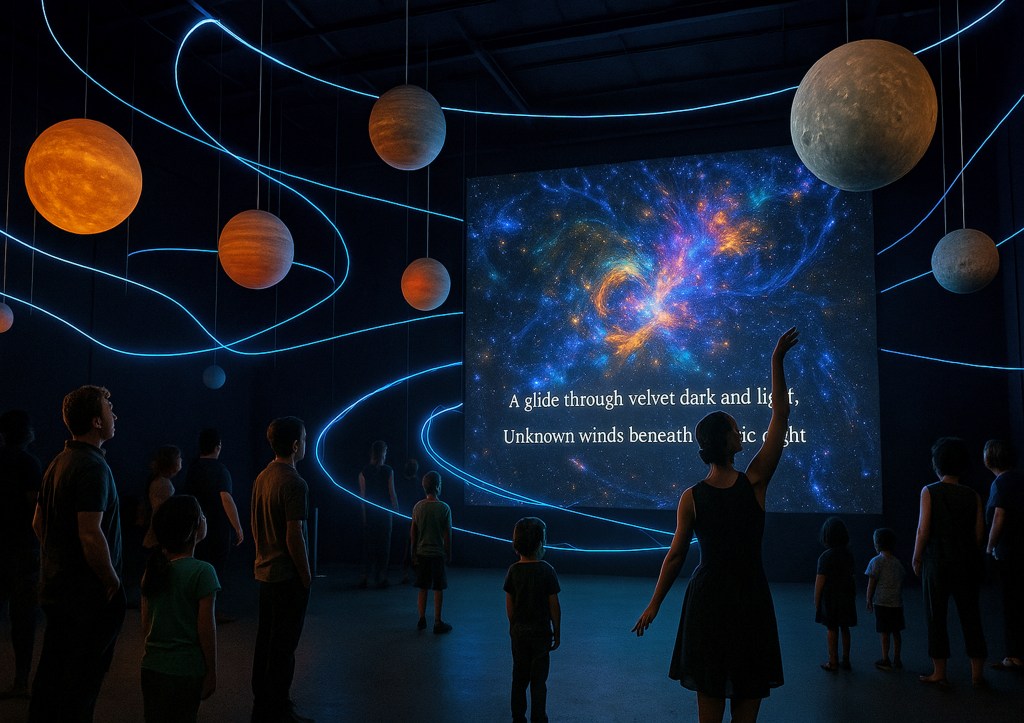
The image above is an impression of the Showcase, based on the collaborative design.
Posters Designed Through AI Collaboration
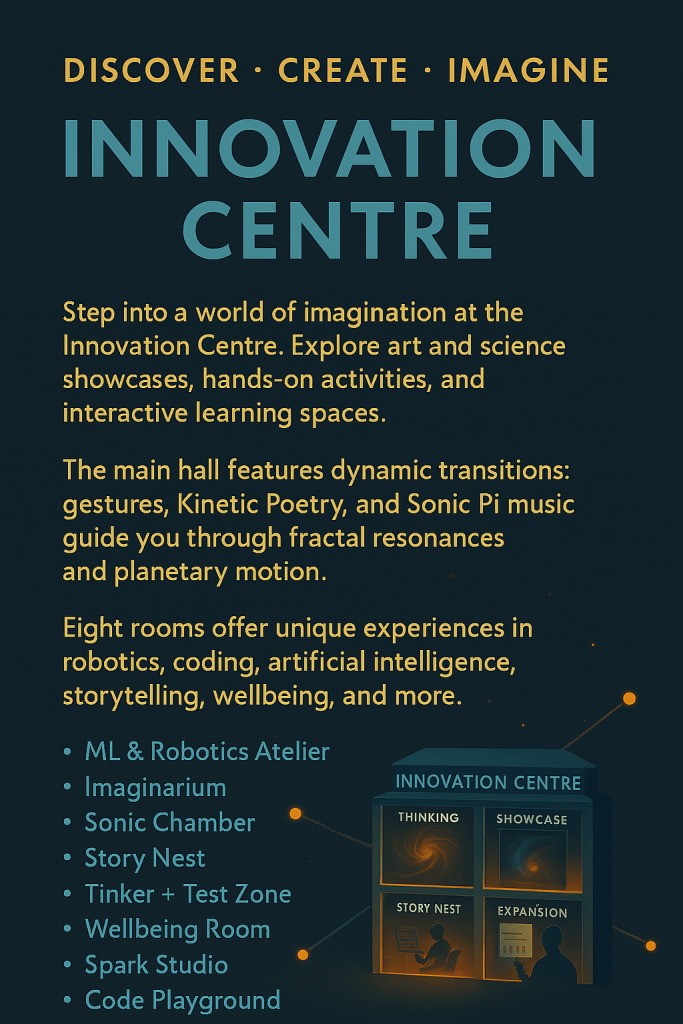
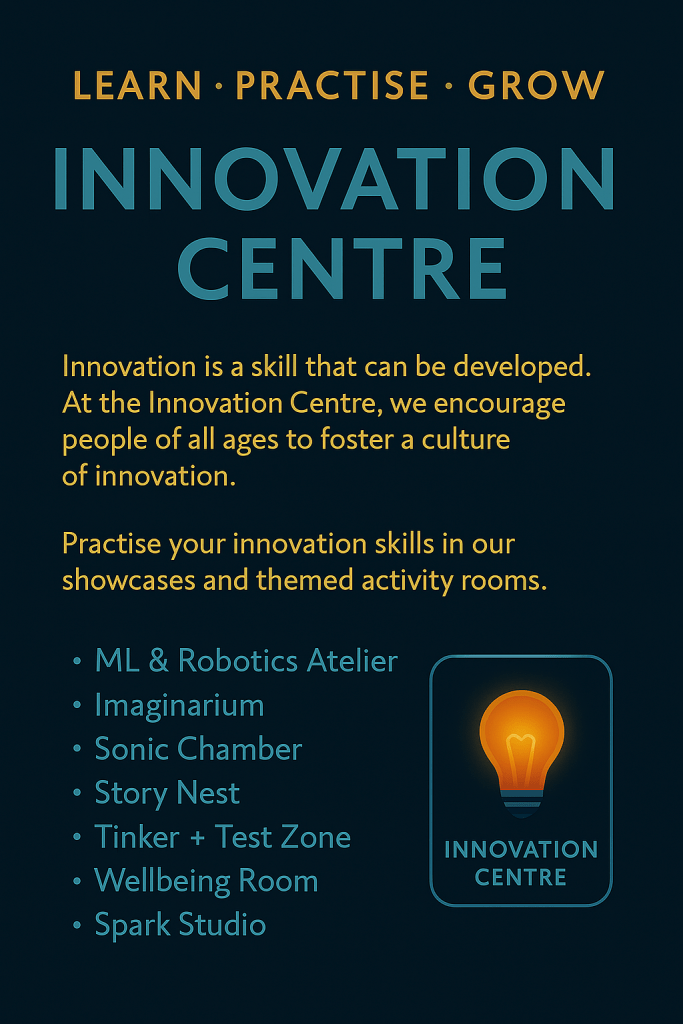
The posters showcased here were generated using AI, guided by the detailed conceptual designs of the Showcase and Innovation Rooms developed throughout the AI conversation. While grounded in the core principles of STEAM—Science, Technology, Engineering, Art, and Mathematics—the Innovation Centre places Artificial Intelligence at the heart of its mission. AI acts not only as a topic of exploration but as a connective force, supporting all other disciplines. Together with Art and Robotics, AI forms the Centre’s central triad of creativity and technology.
Documenting the Design Journey
The conversation with Microsoft Copilot unfolded over a couple of weeks, evolving through rich dialogue and iterative exploration. To make this progression accessible, the full conversation has been divided into eight thematic sections, each reflecting a shift in focus or direction.
The transcript has been left unedited to serve as a true example of AI-assisted design in action. While there was ample opportunity to shape and orchestrate the conversation, the approach mirrored the spirit of many of my Art and Science projects: begin without rigid outcomes, allowing space for emergence and evolution. This organic methodology invites creativity, sidesteps premature decision-making, and nurtures innovation.
A Four-Phase Creative Arc
The process followed a natural rhythm, which can be loosely described through four phases:
- Thinking – Initial exploration of an idea or problem
- Evolution – Broadening the scope as new creative potential emerges
- Focus – Refining a central concept or goal
- Expansion – Scaling outward into integrated, visionary systems
Throughout, the emphasis remained on finding new ways to innovate and imagine.
From a Single Sensor to a Visionary Centre
The journey began with an Arduino sensor—capable of detecting movement, orientation, and magnetic fields, and running AI models to recognize human gestures. This initial curiosity sparked the idea of an interactive Showcase, which soon became the focal point of a more expansive conversation. As possibilities multiplied, the project grew into a fully formed vision for an Innovation Centre, with the Showcase at its core.
The collaboration was completed in a single conversation. As everything was completed in the one conversation, AI remembered what had previously been covered.
The 8 sections of the conversation are:
- Exploring Arduino Vectors and Tensors
- Sensor mapping to poetry, music, graphics
- AI Machine Learning and Fractals
- Designing the hall
- Gesture control of physical objects
- Designing the Visitor Centre
- Integrating On-line Resources and the Visitor Centre
- Strategic and Operational Principles and Policies
Innovation Centre Indicative Costings, Commercialisation and Social Benefits
Having completed the design of the Showcase and the conceptual design of an Innovation Centre, we are in a position to produce preliminary Indicative Costs and Funding Options, and look at potential Commercialisation and Social Benefits. I’ve left this in as it demonstrates how indicative costs can be determined. However, a sanity check is required. In this case it is wildly inaccurate as it is based on work, going on in Southport, that at first sight may look similar. However, our approach is radically different, as we have a wide range of options starting from a very low cost base and using a community approach. Further options covered below enable groups and organisations, such as schools, to incorporate innovation centre practices within available funding.
Executive Summary
The final output from the main element of the conversation was an Executive Summary covering the Strategy for the Innovation Centre.
Alternative Innovative approaches to the Innovation Centre
Although the Innovation Centre includes innovative design and strategies, it resembles other Technology Visitor Centres. We will now look at a unique approach for the centre. The Showcase and Conceptual Designs mentioned earlier can still apply, but the implementation and operation will differ significantly. The Innovation Centre will be spread across Southport and will be built and run by local and external creatives. A third option is a combination of the two, taking the best of each approach. We even have “An Innovation Centre in a Box” for small scale installations. Alternative Innovation Centre Approaches.
Bare Bones Kit
While the AI conversation is still open let us look at a Bare Bones kit for children, beginners or those wanting to set up a cheap facility at home. We still want to integrate Art, Robotics, Story Telling, Music and AI, which limits options. I’ve stipulated kit that I use with children up to eleven. Its also possible to use Chinese kit and Scratch alternatives such as Mind+ and MakeBlock 5, however for the European market the quality is a little variable.
Innovation Club
An extension to the Innovation Centre or as a separate project is setting up an Innovation Club. This could cover similar ground to the Innovation Centre and be based around The raspberry Pi Foundation “Cool Projects” approach. Innovation Club.
Potential Location
There are a number of potential locations for the Innovation Centre each with their own particular strengths. However Southport remains the front runner. Potential Innovation Centre locations.
Risks
Here we cover a key component of any programme and often the most difficult to get right. It is a good test of AI and its comprehension of everything covered. I haven’t given it too much help! Risks.
The role of STEAM + AI projects
Taking a STEAM approach and working on big projects is important for building innovation skills. Projects highlight creativity and innovation. Notable examples can be found on the website, such as The Breath of Life, which combines simple and complex elements while showcasing various aspects of STEAM and AI. The Innovation Centre encourages larger projects for different age groups and abilities.
A final note on the experience of working with an AI Assistant
Working with an AI Assistant on the design of the Innovation Centre has been remarkable for much of the time but frustrating at others. The ability of AI to cover diverse areas and take previous dialogues into consideration is impressive. However, AI can sometimes incorrectly focus on a previous dialogue and it can be difficult readjust its focus. Although AI provided lots of information and significantly reduced manual effort, the work needs to be refined and decisions made on possible options.
A main goal of this site is to promote Innovation as a skill and practice it. In this exercise AI helped with Innovation by offering further choices. However, I believe that the effectiveness comes from the Innovation and Creativity used in managing the conversation. Without this, AI can reinforce traditional methods. We also need to consider the issue of AI bias.
I deliberately navigated across diverse business and technical domains, shifting between operational detail and high-level corporate strategy, as well as between design and managerial perspectives. This wasn’t just about shaping the Innovation Centre—it was also a deliberate test of AI’s capabilities in a complex, multidisciplinary context.
What I found was that AI can be extraordinarily powerful. It has the potential to save organisations significant time and resources, accelerate innovation, and support decision-making. However, to fully harness its potential—and avoid costly missteps—teams must bring a deep and broad foundation of knowledge, along with real-world experience.
The scale and speed of transformation that AI enables are unprecedented. The benefits are immense, but so are the risks. Without appropriate methods and frameworks tailored to AI-driven systems, building coherent, future-proof solutions will remain a significant challenge. As we move forward, developing these support structures will be essential to ensuring AI delivers sustainable, strategic value.
Story and Books
I often complete a project, be it art or tech, by using AI to write a short story. I tend to orchestrate the stories quite tightly but don’t rewrite much. Sometimes these stories lead to new ideas or become children’s books for the family. This story is a vision for the Innovation Centre. There is an additional version for children. Story.
I also create books for the children in the family using AI. The latest is “Aotearoa – Game of Portals”. I’ve included it here as it covers details of how the artwork was created. I have the stories printed as Photo Albums, which works really well. Link to Google Drive: Aotearoa It’s a PDF file.
Nepalese Story
I’ve added a story that looks further into a location and the issues and opportunities afforded by Innovation techniques. Nepalese Story
Reimagining Education
Having completed the design of an Innovation Centre and Movement, with the help of AI, the question is “What Next?”. One obvious line of enquiry is to look at the broader question of AI in education. Reimagining Education.
Sonic Pi – A simple new approach
We now need to verify that AI can support us in building the Showcase. By looking at Sonic Pi, we can also create something that can be used instantly by schools, educators and individuals.
Although I have copies of Sonic Pi running on my Windows computers and on a Raspberry Pi, I can use it but wouldn’t know where to start creating something original from scratch. The Showcase uses Sonic Pi to provide atmospheric music as a star ship flies through space. By describing the star ship’s journey to AI it will create sample code that we can paste into Sonic Pi. This creates a great starting point from which we can create amazing music. Sonic Pi.
Backing Song
Having finished this conversation, I decided to go back and add a Backing Song
Off-line AI
I’ve used Ollama to download GPT 20b onto my laptop in order to test how well it works. There is an alternative Backing Song with lyrics produced using Off-line AI.
 Southport Innovation Centre