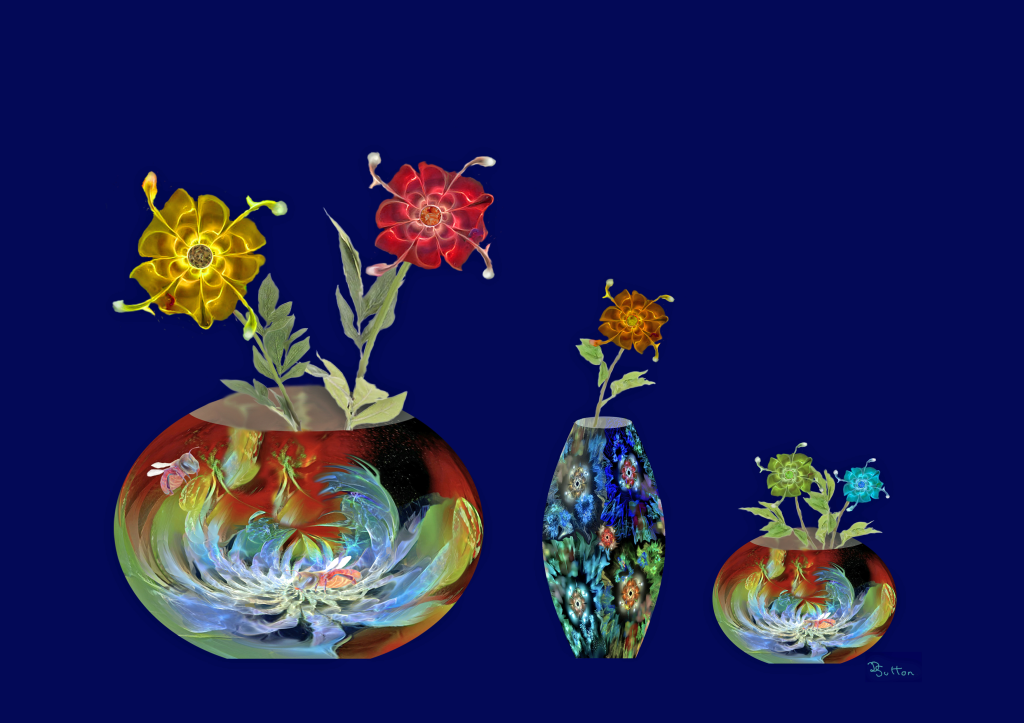
This is one of my first and favourite images. The aim was to illustrate how natural looking images could be produced using fractal geometry and Chaos Theory.
Like AI, fractal images can be produced very simply or by using complex processes that take time to master. This image took quite a long time to produce. The bee took about three weeks. Creating fractals takes time to master the process and the apps, which can be quite complex. However, the most interesting feature is that they use non-linear maths. This results in strange behaviours where minor changes can have major impacts and large changes can have virtually no impact. Imagine painting a picture where pressing slightly harder on the brush can, without warning, transform the picture.
The only real parts of the image are the leaves, which are photographs. Vertically everything else is composed of complex fractal graphics. The process was far more complicated than I originally intended.
The processes started by creating a few complex fractal graphics
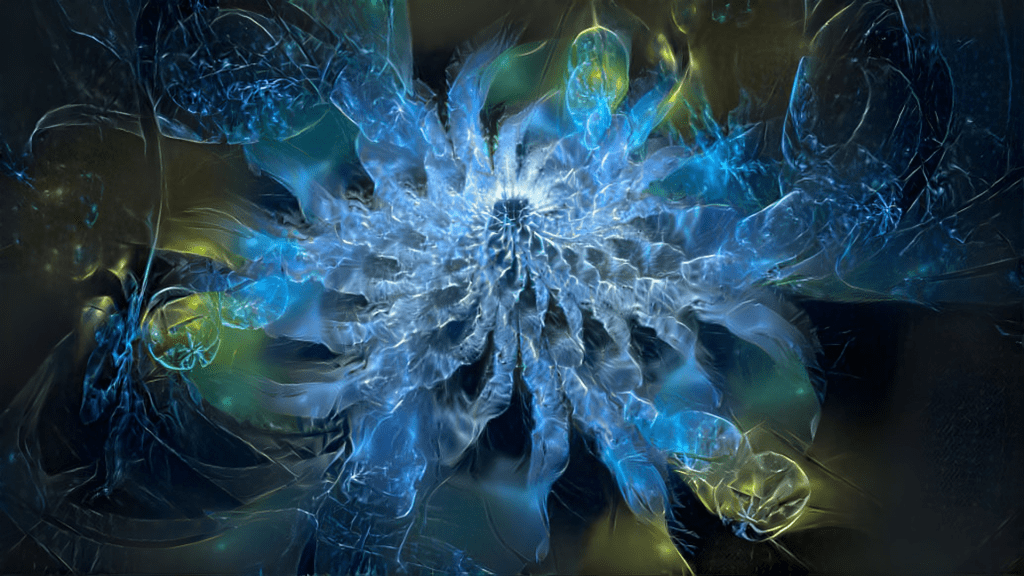
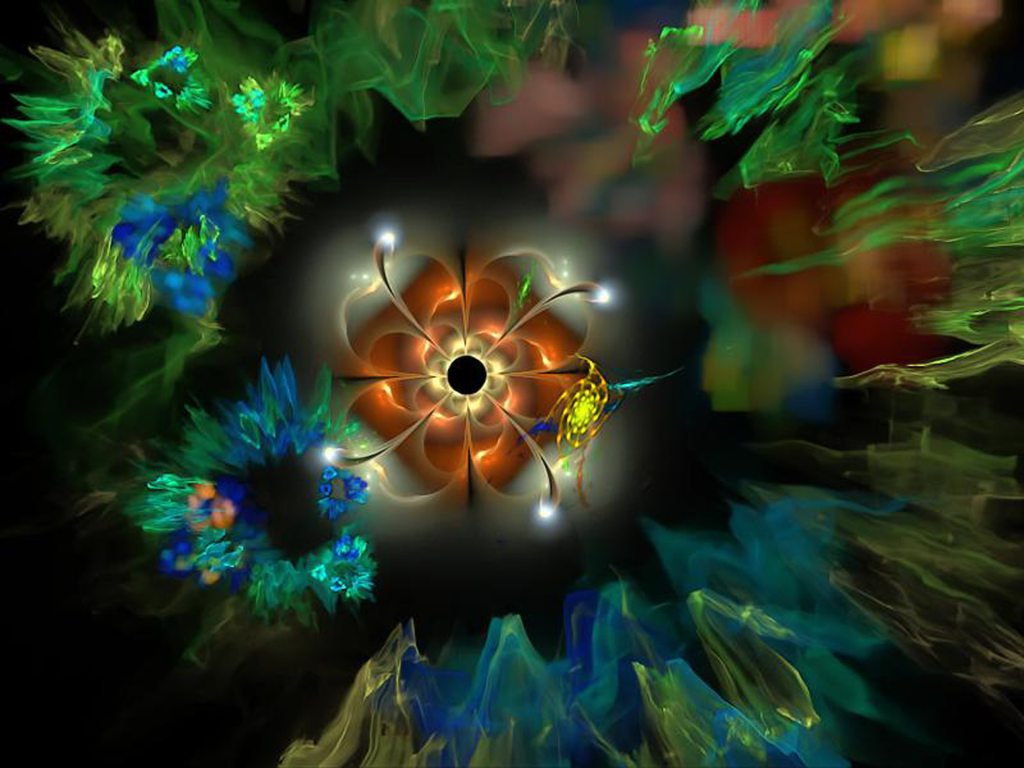
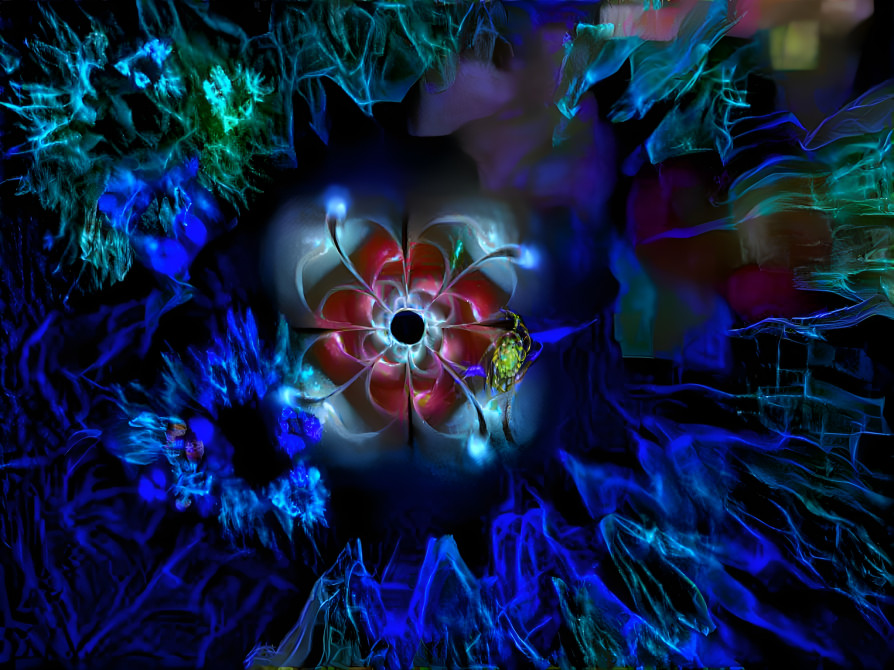
AI was used but only to restyle the graphics by altering the colours and to modify the shape to a minor degree. Each of the flower shapes, on the central vase, is a different colour and a slightly different shape.
Most of the work involved combining the fractals graphics and reshaping them to form the vases. This was all done using a photo editor.
Whilst working on this I was involved in Citizen Science, training AI to recognise pollinators in the Arctic. Unfortunately my involvement was purely working from home classifying images as either containing pollinators or not. This gave me the idea of adding the bee.
The bee started out as a sketch I did on my ipad. However, the wings were fractal graphics and the body was created using a graphic I created using code (Processing). The coding took some time to get right. I finally used AI to slightly modify the image. I created two very similar images, one where the wings were made from fractals graphics and the other where they were photographs I took of an insect wing using a simple microscope. The final result isn’t too good but the process was interesting and fun.
A key element of my approach to combining art and science, is that you can always revisit projects. Usually this when you find something that inspires you. Its important to create libraries of information and images for later use. Also to make note of interesting snippets. I had been watching an amazing episode of Gardeners World where a plant scientist described how bees are born with little knowledge but with the capability to learn quickly. Plants and flowers are designed to “teach” bees to gather pollen. For me the complex interaction described was far more interesting than the standard version and also what you get if you ask AI. I had stored away a few interesting facts about research into training plants and the amazing capabilities of Slime Mold. I felt that I could pick up the previous work and use AI to investigate pollination more deeply. This is a longer term project that I’ll add to periodically.
AI provided lots of interesting information but far from the inspirational Gardeners World story. It provided a standard view and it wasn’t possible to produce anything inspirational without prior knowledge. Also the conventional, simplified view, varied from the expert’s view. However, by pointing AI towards something I was aware of (teaching plants), it filled in some gaps.
I’ve only included the final summary information provided by AI.
Sent by you:
How do the intricate and complex designs of flowers and bees work together, to educate and to train bees, and create a remarkable pollination system.
Sent by you:
How does a flower train a bee to identify where it stores pollen to be collected and where it requires pollen to be delivered.
Summaries (The responses contain lots of fascinating information but are far from the inspirational details provided by the expert)
Copilot:
Flowers and bees engage in a delicate dance of mutual benefit, orchestrated by millions of years of co-evolution. Let’s explore how flowers “train” bees in their intricate pollination system:
Gemini:
Flowers don’t explicitly train bees. Instead, they rely on evolutionary adaptations and cues that guide bees toward specific actions. Here’s how this process works:
 Southport Innovation Centre